
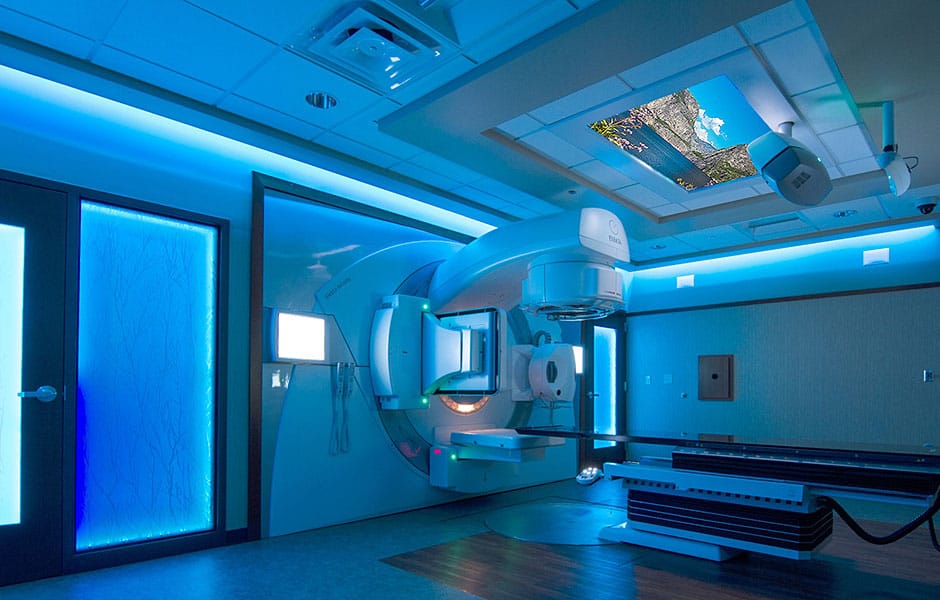
With more than 20 years of digital signage experience, Norvision knows healthcare environments need more than screens: technology must fit clinical workflows and support the people receiving care. In radiation vaults and imaging rooms, that can include a ceiling display that gives patients a calmer view while they lie still for treatment or a scan.
But can simulated sky and nature visuals actually reduce anxiety? Research offers encouraging signs, but it does not support a promise that a display will work for every patient or replace clinical care. Here’s what the evidence says, and what to consider before adding a ceiling video system to your facility.
What the research says about calming visuals
A treatment room can feel unfamiliar and intimidating. Patients may be asked to lie still, look up at unfamiliar equipment, or spend time alone in a room while staff operate equipment nearby. Environmental design cannot remove the reasons a patient may feel anxious, but it can influence how the space feels.
Several studies offer relevant findings:
- Ceiling artwork in radiation therapy: A study at Sunshine Hospital Radiation Therapy Centre surveyed 41 patients about ceiling artwork in CT rooms and radiation therapy bunkers. Across the survey responses, 89.8% were positive. Patients reported that the displays improved the treatment environment and their experience. This is useful evidence about patient perceptions, but it was a small survey, not a controlled trial measuring anxiety before and after exposure. Read the study.
- Moving nature projections in CT: A quasi-randomized study of 97 patients found that a motion-nature projection made the room feel more pleasant. The researchers also reported lower perceived anxiety and lower heart rate and diastolic blood pressure compared with no projection. The findings point to a possible benefit, though they do not establish the same effect for every type of display or clinical setting. Read the study.
- Radiation therapy interventions overall: A systematic review examined nonpharmacological approaches to procedural anxiety in adult radiation therapy patients. It found limited, varied evidence across approaches such as music and educational videos, and called for more rigorous research. The review did not establish ceiling displays as a proven anxiety treatment. Read the review.

The practical conclusion: simulated nature may support a more pleasant patient experience and can be a useful environmental design choice. The evidence is promising, but limited. Keep it simple: a Digital SkyLite is best understood as a patient-comfort feature, not a clinical intervention with guaranteed results.
Why the ceiling can be a useful place for visual content
During imaging or radiation therapy, patients may be positioned on their back with their view directed upward. A ceiling display makes use of that sightline without asking patients to hold a device, turn their head, or interact with a screen.
Depending on the room and treatment workflow, a ceiling display can offer:
- A visual alternative to a plain ceiling or exposed equipment.
- Nature scenes, sky imagery, or other calming content selected by the care team.
- A consistent experience that staff can offer across appointments.
- Optional audio, where appropriate and supported by department protocols.
Patient preferences vary. Some may welcome a peaceful landscape; others may prefer a simple sky scene, no motion, or no content at all. Give patients a choice when your workflow allows it, and make sure the display can be turned off or adjusted when needed.
Plan for the room before choosing the display
A successful healthcare digital signage installation starts with the clinical space, not the screen. Radiation vaults and imaging rooms have specific constraints, so involve facilities, IT, clinical engineering, radiology or oncology staff, and the appropriate equipment specialists early in planning.
Review these factors before selecting a system:
- Ceiling height and viewing angle. Confirm that patients can see the display clearly from the treatment position. Consider equipment booms, gantries, lights, and other ceiling elements that could block the view.
- Room configuration. New construction and retrofit projects have different requirements. Map out the intended placement, mounting method, service access, and cable routing before finalizing the design.
- Clinical and technical compatibility. Ask the equipment manufacturer and hospital engineering team to review the proposed installation, including any electrical, electromagnetic, safety, infection-control, or service-access requirements relevant to the room.
- Operational workflow. Decide who selects or approves content, how staff start and stop playback, and what should happen if the display is unavailable during a treatment.
- Accessibility and patient choice. Consider content with gentle movement and clear, comfortable imagery. Provide a way to accommodate patients who prefer a static scene, a blank screen, or different content.
Norvision’s Digital SkyLite in-ceiling video system is designed for radiation vault applications and can be configured for different room requirements. Norvision also brings experience working with cancer centers, where the display must fit the treatment environment as well as the patient experience.

Curate content for comfort, not spectacle
The most impressive content is not always the most appropriate. In a treatment setting, the goal is to create a calm, predictable visual experience that supports patient comfort and does not compete with care.
When reviewing content, consider:
- Choose gentle visuals. Favor clear, natural scenes and gradual transitions over rapid cuts, flashing effects, or busy graphics.
- Offer variety without overwhelming patients. A small, approved selection can make choice manageable for patients and staff.
- Ask patients what they prefer. Some may find moving images relaxing; others may prefer still landscapes, a sky scene, or no display.
- Keep the content appropriate to the setting. Review imagery and audio for cultural sensitivity, emotional tone, and relevance to your patient population.
- Make audio optional. Music or nature sounds may suit some patients, but should not be assumed to suit everyone or every procedure.

Include monitoring and ownership in your plan
A ceiling video system is part of your digital signage infrastructure. Decide how it will be managed after installation, not just how it will look on opening day. Assign responsibility for content approval, access permissions, and routine checks. Make sure staff know how to report a problem and who to contact if playback, audio, or the display itself needs attention.
For a consistent patient experience, build these practices into your plan:
- Check that the display is working and showing approved content.
- Confirm that staff can control playback using the agreed process.
- Review the content library periodically with the clinical team.
- Track service issues and response times.
- Gather patient and staff feedback to guide adjustments.
A managed platform and ongoing support can help reduce the burden on clinical teams. Norvision provides professional installation nationwide and 24/7/365 monitoring support for its digital signage solutions. Discuss the specific monitoring and service options for your project during planning.
How to evaluate whether it is helping
If patient experience is a priority, decide in advance how you will evaluate the display. A simple pilot can help you understand whether the content is useful to your patient population and workable for staff. It should not be presented as a clinical study unless it is designed and reviewed as one.
You might ask patients whether the display made the room feel more comfortable, whether they liked the content, and whether they would prefer different options. Staff can share whether playback fits the workflow and whether the system is easy to operate. Keep feedback voluntary, and follow your organization’s privacy and research policies.
A thoughtful addition, not a substitute for care
The research suggests that nature visuals and thoughtfully designed treatment spaces may improve how patients experience imaging and radiation therapy. Some studies report reductions in anxiety or physiological arousal, while others measure patient perceptions rather than clinical outcomes. Overall, the evidence is encouraging but not conclusive.
For hospital administrators and department leaders, the useful question is not whether a ceiling display can eliminate anxiety. It is whether a carefully planned, well-managed display can offer patients a more supportive environment without disrupting care.
Keep it patient-centered. Keep it simple. And make sure the technology fits the room, the workflow, and the people who will use it.
To discuss a Digital SkyLite for your cancer center, contact Norvision or call 480-447-4260. We can help you review your room requirements and plan next steps.